Water as a Negentropic Converter: A Hypothesis on Biological Organization and the Quantum Electromagnetic Environment
Conceptual perspective & research hypothesis
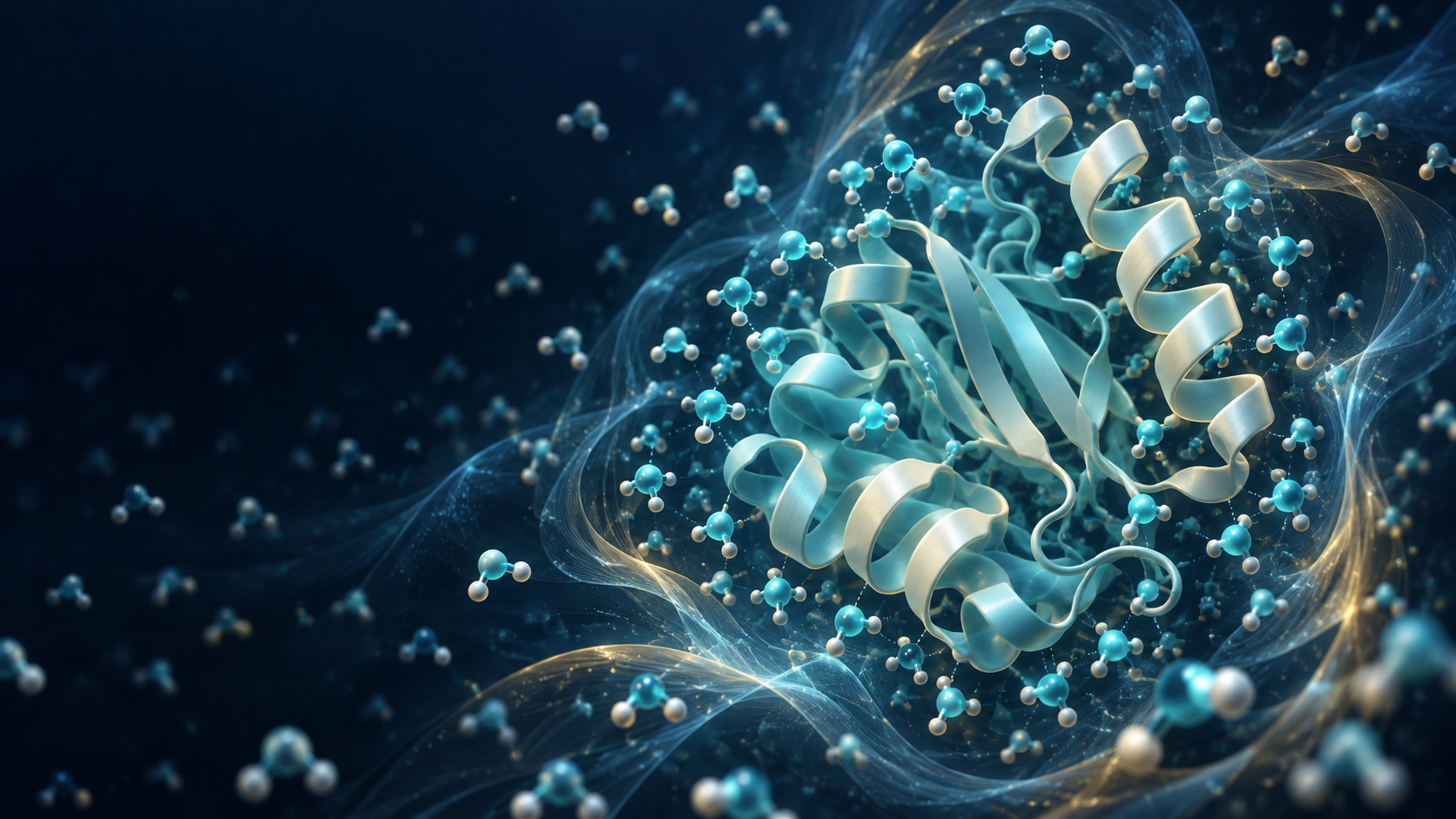
Life depends on the coordination of molecular interactions. Proteins change shape, membranes sustain gradients, and reaction networks continually rebuild the conditions necessary for their operation. Water participates throughout these processes, helping shape the molecular environment in which biological activity unfolds.
I propose that this organizing participation can be understood through the concept of water as a negentropic converter: a dynamic substance that helps translate available free energy into functional biological organization. My further hypothesis is that this role may involve interactions with the quantum electromagnetic field, particularly where biological structures selectively shape—or “filter”—the fluctuations experienced by water.
This proposal connects research on hydration and biomolecular dynamics with an emerging question: could the electromagnetic environment influence how water coordinates biological interactions?
Water as an active participant
Water’s active participation is visible at the scale of individual proteins. Oroguchi and Nakasako investigated how hydration changes accompany the opening and closing of a protein’s active-site cleft. Their simulations, supported by structural and biochemical experiments, showed how rearrangements of nearby water networks can act as switches for larger protein motions. The protein and its hydration environment form a coupled system whose behavior depends on both components. (Oroguchi & Nakasako, 2016)
This provides a concrete starting point for the converter concept. Energy supplies the capacity for change, while molecular geometry, hydration, and interaction strengths shape the pathways that change can follow. Water participates in establishing those pathways and responds as biomolecules move through them.
Here, “negentropic” describes the proposed contribution to maintaining local biological organization within an open system. Metabolic flux and other available free-energy sources sustain that organization, with entropy exported to the surroundings. The relevant organization is dynamic: productive molecular motions, selective interactions, and coordinated reaction sequences. Greater rigidity or a more ordered molecular arrangement need not improve biological function.
An experimental connection: enzymes and coupled water
A particularly direct experimental connection comes from research on vibrational strong coupling. Under suitable conditions, molecular vibrations interact with a resonant electromagnetic mode strongly enough to form hybrid light–matter states called vibrational polaritons. Vergauwe and colleagues investigated whether coupling water in this way could influence the activity of pepsin, an enzyme that cleaves peptide bonds. Water participates both in the enzyme’s surrounding environment and directly in its reaction mechanism. (Vergauwe et al., 2019)
The researchers reported an approximately 4.5-fold decrease in pepsin’s apparent catalytic efficiency, kcat/Km, when water’s OH stretching vibration was coupled to a Fabry–Pérot cavity. Coupling the bending vibration produced no detectable change under their experimental conditions. They considered changes to active-site chemistry and enzyme conformation as possible explanations. This result provides a specific precedent for investigating how the electromagnetic environment of water can influence biochemical activity. (Vergauwe et al., 2019)
For the proposed organizing role of water, the direction of the effect is significant. Coordination can involve suppressing one pathway, stabilizing an intermediate, or changing the relative timing of reactions. The hypothesis therefore concerns how water shapes biological activity, rather than predicting a universal acceleration of it.
What “filtered” fluctuations could mean
By “filtered vacuum fluctuations,” I mean the selective shaping of the electromagnetic environment by material structure and molecular response. Vacuum electric-field fluctuations possess correlations across space and time; these coherence properties have been investigated experimentally through field-correlation measurements. Resonances and interference in a structured environment can enhance some electromagnetic contributions and suppress others, changing the fluctuations to which molecular motions couple. The proposed biological extension is that water’s interaction with such an environment may influence hydration dynamics and biomolecular coordination on relevant molecular timescales. (Benea-Chelmus et al., 2019); (De Liberato, 2019)
In this picture, biomolecular structures shape their electromagnetic surroundings; water responds to those surroundings; and its response influences neighboring biomolecules. Establishing whether this reciprocal interaction contributes appreciably to biological organization requires measurements of coupling strengths, losses, and functional consequences in defined systems. The proposed field contribution concerns the conditions governing molecular behavior, while sustained biological activity draws on the system’s available free energy.
A reciprocal relationship
Structure shapes the field environment. Water responds. Biomolecular interactions change.
Field environment
Geometry and resonances shape the available electromagnetic modes.
Hydration dynamics
Water reorganizes as it interacts with fields and molecular surfaces.
Biomolecular response
Conformation and reaction pathways feed back into the local environment.
Testing the idea with gold bowtie arrays
An experimental platform for investigating this relationship is provided by Verdelli and colleagues. They fabricated arrays of gold bowties supporting collective electromagnetic modes called surface lattice resonances, which coupled to water’s OH stretching vibrations. The measured Rabi splitting was 567 cm−1, with a coupling strength approaching the conventional onset of the ultrastrong regime. These arrays offer an accessible platform for examining water–field interactions and their chemical consequences. (Verdelli et al., 2024)
I propose extending this approach to an enzyme reaction in a thin aqueous chamber above a bowtie array. Pepsin acting on a defined peptide substrate would provide continuity with the earlier cavity experiment. Comparing arrays resonant with water’s stretching vibration against detuned and unpatterned controls would test whether changes in the electromagnetic environment produce reproducible changes in catalysis.
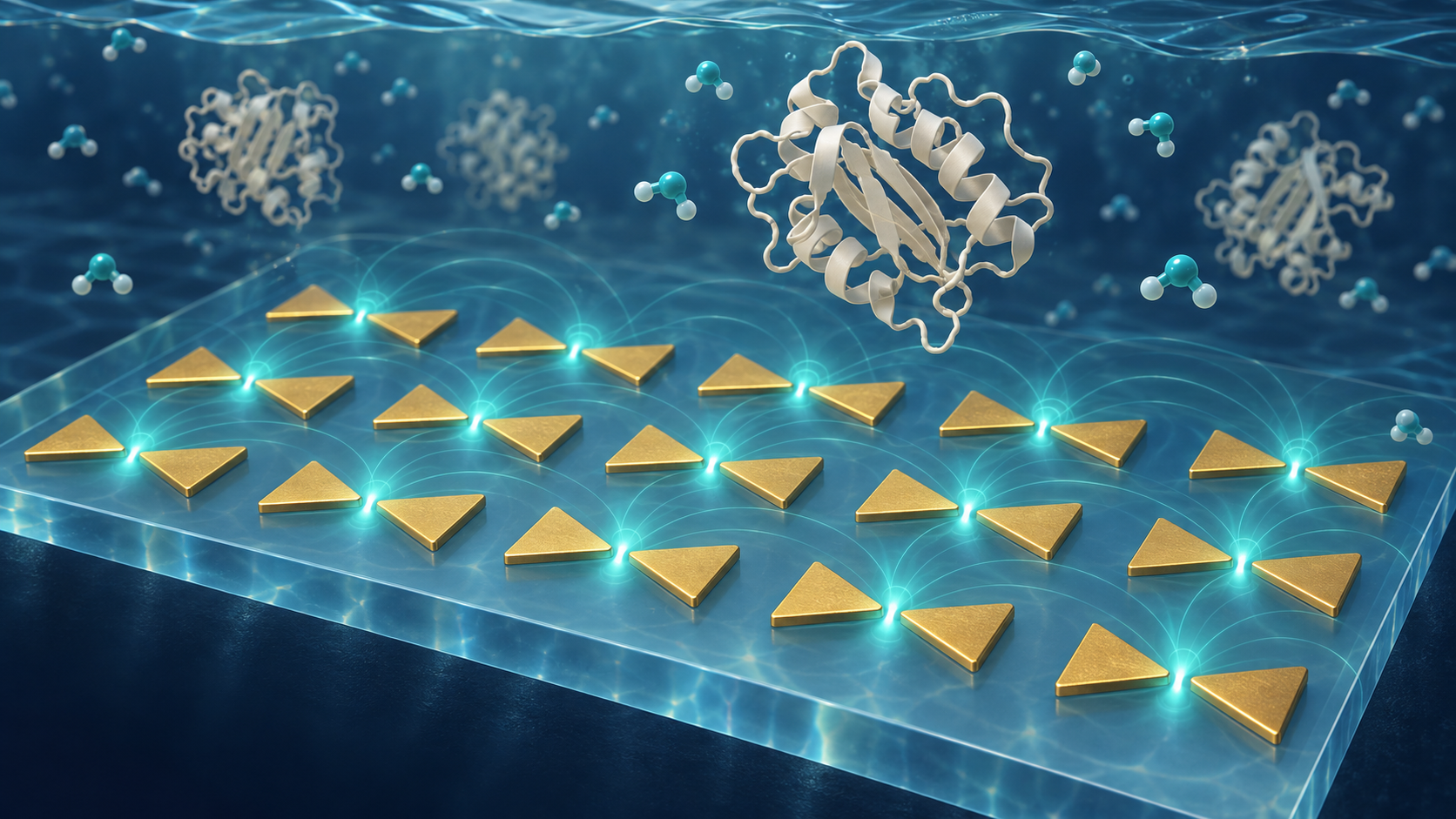
The coupling would first be characterized in the complete reaction mixture, including buffer, enzyme, substrate, and any protective surface coating. Measurements across substrate concentrations would then determine how the environment affects catalytic turnover and substrate dependence. Product formation could be quantified independently by chromatography, with temperature, surface adsorption, and illumination controlled across conditions.
The spatial relationship between the enzyme and the coupled water would also be central to the design. Modeling the electromagnetic modes and controlling the chamber geometry would help determine how much of the reacting solution occupies the relevant interaction region. Complementary measurements of hydration dynamics or protein conformation could connect the optical and biochemical observations.
From coupled water to catalytic activity
Measure the optical environment and the biochemical response in the same reaction mixture.
Gold bowtie array · water-filled chamber
Pepsin + peptide substrate → products
Determine catalytic turnover and substrate dependence across matched conditions.
Together, these experiments would test a specific part of the negentropic-converter hypothesis: whether shaping water’s electromagnetic environment changes the molecular pathways through which biological activity proceeds. Subsequent studies of competing reactions or coupled enzyme networks could examine how those changes influence selectivity, coordination, and the persistence of functional organization.
- Oroguchi, T., & Nakasako, M. (2016). Scientific Reports, 6, 26302. doi:10.1038/srep26302.
- Vergauwe, R. M. A., et al. (2019). Modification of Enzyme Activity by Vibrational Strong Coupling of Water. Angewandte Chemie International Edition, 58(43), 15324–15328. doi:10.1002/anie.201908876.
- Benea-Chelmus, I.-C., et al. (2019). Nature, 568, 202–206. doi:10.1038/s41586-019-1083-9.
- De Liberato, S. (2019). Physical Review A, 100, 031801. doi:10.1103/PhysRevA.100.031801.
- Verdelli, F., Wei, Y.-C., Scheers, J. M., Abdelkhalik, M. S., Goudarzi, M., & Gómez Rivas, J. (2024). Ultrastrong coupling between molecular vibrations in water and surface lattice resonances. Journal of Chemical Physics, 161(18), 184709. doi:10.1063/5.0231198.
Illustrations: AI-generated conceptual artwork created with OpenAI image generation. Animated schematics illustrate the proposed mechanisms and experiment.
