Mitochondrial Polaritons and My March 2026 Prediction

Artist’s impression of proposed mitochondrial light–vibration coupling. The gold wave is a visual metaphor, not a microscopy image or measured field map.
A new study brings an idea I have been investigating for the past year into experimental focus.
For the past year, I have been investigating whether mitochondria can support hybrid states of light and molecular vibration. In March 2026, I discussed this possibility publicly during a Think Beyond webinar: mitochondrial structures might provide environments in which electromagnetic fields and molecular vibrations become coupled into shared modes, known as vibro-polaritons.
The recent paper A quantum state of mitochondria in the living cell makes this an especially timely question. What follows is my reading of its significance, the connection to my earlier proposal, and the experimental work that could take this research forward.
The public record of my prediction
My Think Beyond presentation took place on March 10, 2026, with the recording uploaded the following day. The mitochondrial discussion is around the 46–47 minute mark; the link below opens at 47:06, within the chapter titled Mitochondrial microcavities. The event description also explicitly identifies vibro-polaritons in cellular water and biomolecules as a subject of the talk. [1, 2]
The prediction I am highlighting is the possibility of mitochondrial vibrational light–matter hybridization. My broader investigation includes water, biological interfaces, and the electromagnetic environment experienced by molecular oscillators. This was a proposal about a physical mechanism and where to look for it, rather than a claim that I had already measured such a state.
That distinction matters for the chronology. The March recording documents the direction of my thinking before the September preprint. It should not be read as a prediction of the particular frequencies or numerical ATP response reported by another research group.
Watch the March 2026 discussion from 47:06 →
What the new study reports
Yu Yang, Zhenglong Gu and Bo Song posted their study on bioRxiv on September 15, 2026; it has not been peer reviewed. Infrared spectroscopy revealed a 71 THz shoulder in living cells, mouse tissues and isolated mitochondria. Their model couples light to lipid CH₂ vibrations near 87 THz, producing proposed branches at 71 and 103 THz. The upper branch was not separately resolved. The model’s resonator extends along the mitochondrion; cristae supply the molecular oscillators. [3]
After ten minutes of illumination at 71 or 87 THz, cellular ATP content rose approximately 10%; a 53.7 THz control produced no significant change. The assay measured ATP abundance, not synthesis rate. The spectral shoulder lies near CO₂ absorption, and the disrupted controls were dried and measured with a different spectroscopic configuration. The polariton interpretation therefore remains to be independently established. [3]
What a vibro polariton actually is
A molecule can absorb infrared radiation when the oscillating electric field interacts with a vibration that changes its electric dipole. Usually, we describe the electromagnetic field and the molecular vibration separately. In the strong-coupling regime, their interaction becomes sufficiently rapid relative to losses that the appropriate description involves two shared modes, each containing both electromagnetic and vibrational character.
A useful analogy is two pendulums joined by a spring. The coupled system has collective motions whose frequencies differ from those of the isolated pendulums. In vibrational polariton physics, the corresponding partners are an electromagnetic mode and a molecular vibration, often involving a large ensemble of molecules. One hybrid branch lies above the original resonance and the other below it. This separation is commonly called Rabi splitting. [4]
The physics is established in engineered molecular cavities. Experiments have also measured altered vibrational relaxation and coherent energy exchange in these systems. Those results provide concrete tools for asking whether related behavior could occur in biological structures. [5]
Why mitochondrial architecture matters
For my research, the central question is whether biological organization helps determine the electromagnetic conditions under which molecules operate. A membrane’s composition, its surrounding water, and the arrangement of neighboring interfaces can all matter to the fields that molecular dipoles experience. The challenge is to calculate and measure that environment rather than infer it from appearance alone.
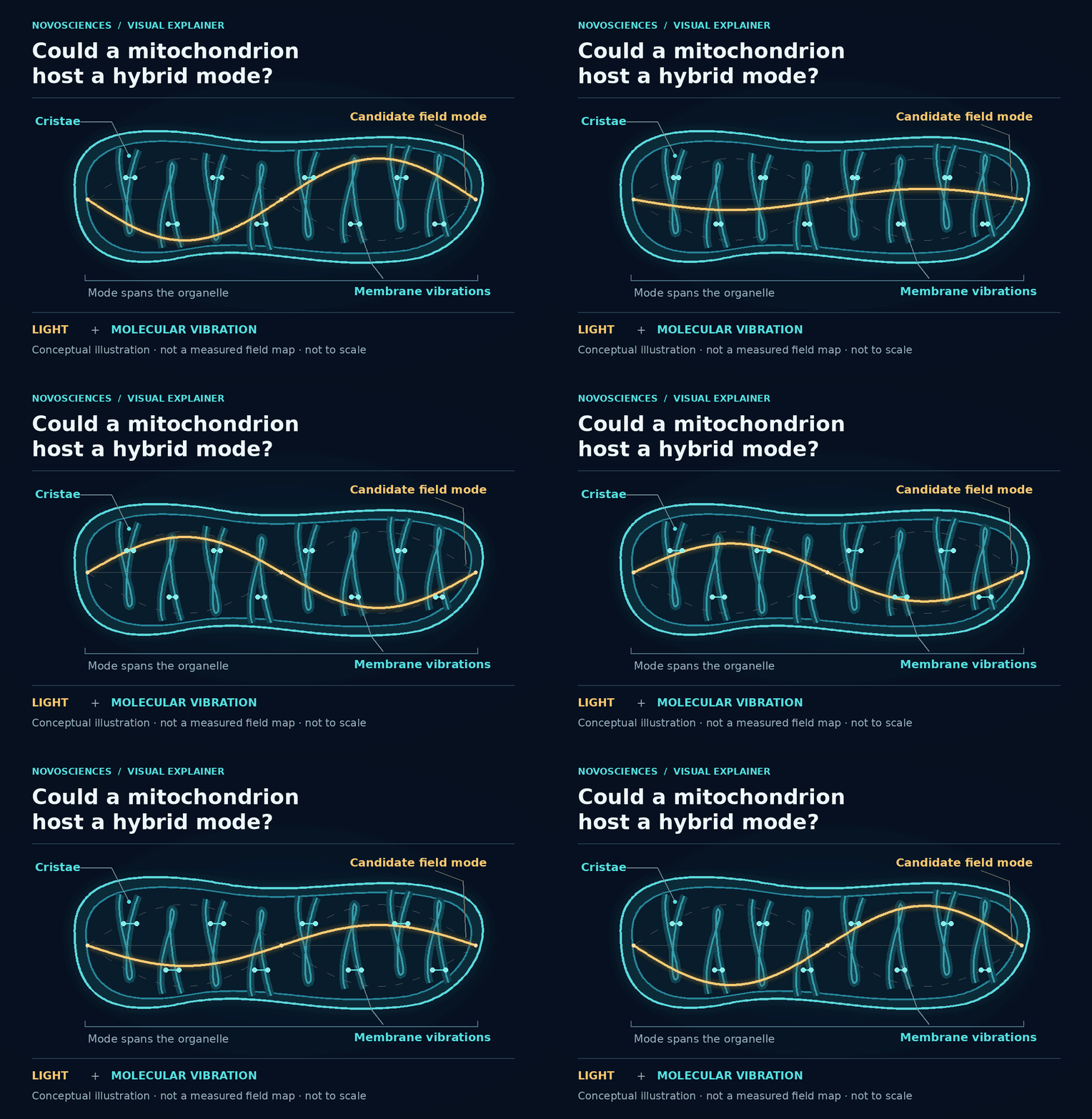
A conceptual electromagnetic mode spans the whole organelle and overlaps molecular vibrations in its membranes. The animation illustrates the proposed coupling; it is not a calculated field map or a measurement of coherent motion.
In particular, a narrow membrane gap is not automatically an infrared cavity. Mid-infrared wavelengths are on the micrometre scale, much larger than many membrane separations. A proposed mode must be supported by the full geometry and dielectric response. Confinement, absorption, molecular density, dipole orientation and the overlap between field and molecules must all enter a realistic calculation.
This is also where the scope of the comparison becomes clear: a lipid-based model and my broader interest in water and biological interfaces are related research directions, not interchangeable microscopic explanations. The useful connection is the shared question of whether mitochondrial organization can enable vibrational light–matter coupling.
How I would test the idea
I would put controlled changes of resonance at the center of the next experiments. If an electromagnetic resonance can be shifted relative to a molecular vibration, strong coupling predicts a characteristic avoided crossing: the two hybrid branches approach one another and then separate, exchanging their light-like and vibration-like character. Measuring this behavior together with linewidths is much more discriminating than assigning a single unexplained feature. [4]
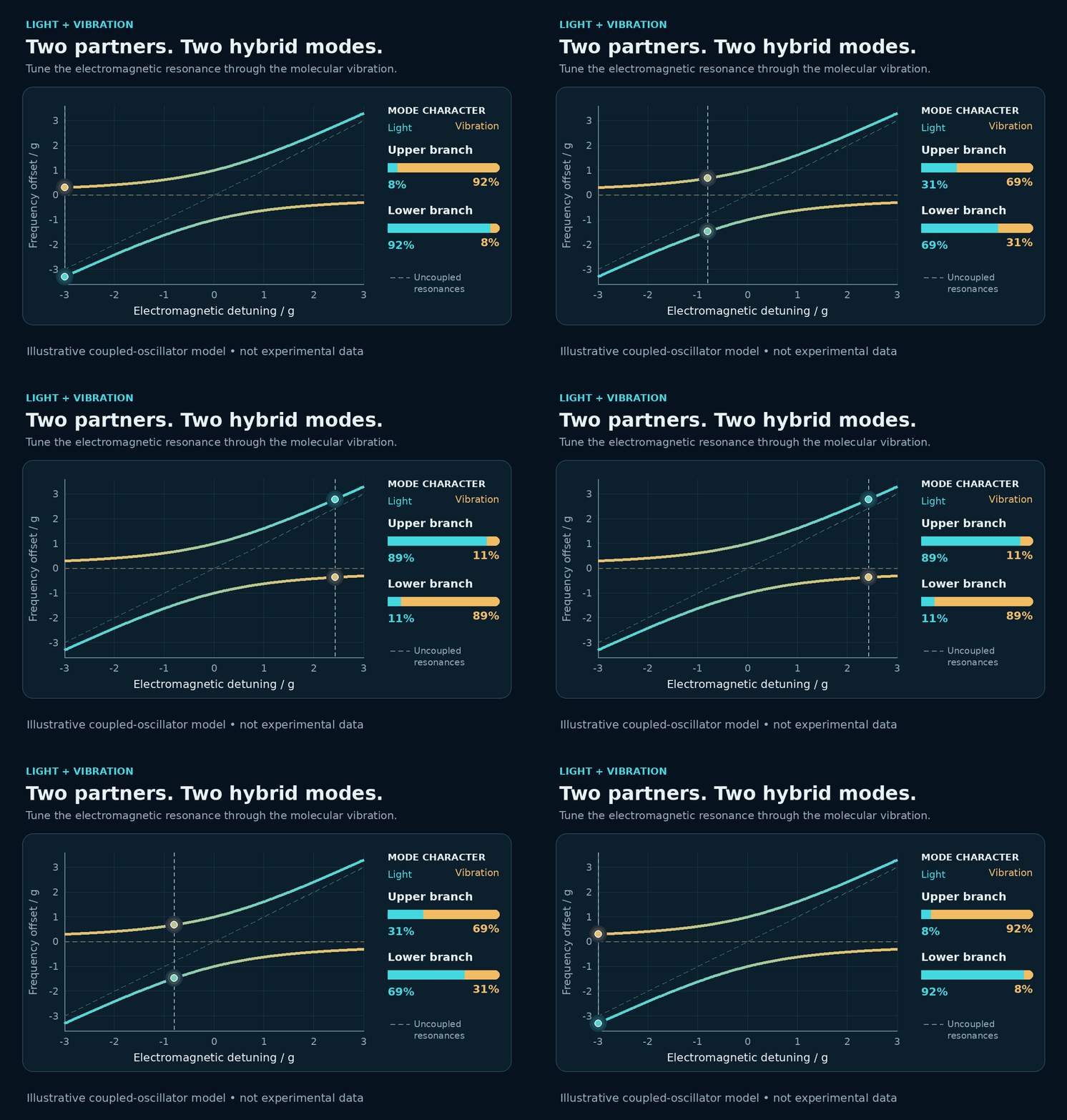
Tuning through resonance produces an avoided crossing in this illustrative model. The two hybrid branches exchange light and vibration character, with a separation of 2g at resonance (g is the coupling strength). This is a proposed diagnostic, not experimental data from the mitochondrial study.
I would also compare intact and perturbed mitochondria under the same optical conditions, while controlling hydration, temperature, gas background and sample handling. Isotopic substitution or a carefully chosen change in membrane composition could help identify which molecular vibration participates, provided the accompanying biological effects are measured too.
For function, I would combine spectroscopy with measurements of respiration, membrane potential and ATP synthesis and consumption. The crucial experiment would connect a predictable change in the proposed coupling to a reproducible change in bioenergetics. Independent replication would then establish whether the behavior is robust across preparations and laboratories.
A further distinction concerns the word quantum. Hybrid-mode spectra can also be described with classical coupled oscillators. Establishing strong coupling, measuring its biological consequences, and demonstrating a uniquely nonclassical state are separate experimental goals. Each calls for its own evidence.
An earlier proposal and an open research program
This work belongs to a wider scientific history. Song and Shu previously proposed vibrational polaritons in the myelin sheath of nerves, in research published online in 2019. My mitochondrial proposal sits within the broader effort to understand whether living structures can sustain and use collective electromagnetic behavior. [6]
What makes the present moment personally significant is the opportunity to place my March proposal beside new experiments and ask more specific questions. The strongest connection is conceptual anticipation: I had publicly identified mitochondrial vibro-polariton states as a possibility worth investigating. The next task is to determine which physical model survives careful measurement.
That is the direction I want to pursue at NovoSciences: connect the structure of living matter to measurable field–matter interactions, and connect those interactions to biological function.
Sources and further reading
1. William Brown — Think Beyond, March 2026 recording, mitochondrial discussion at 47:06
2. International Space Federation — event description and March 10, 2026 date
