Spirals of Memory: Brain Waves, Microtubules, and the Geometry of Recall
NovoSciences · Perspective and hypothesis
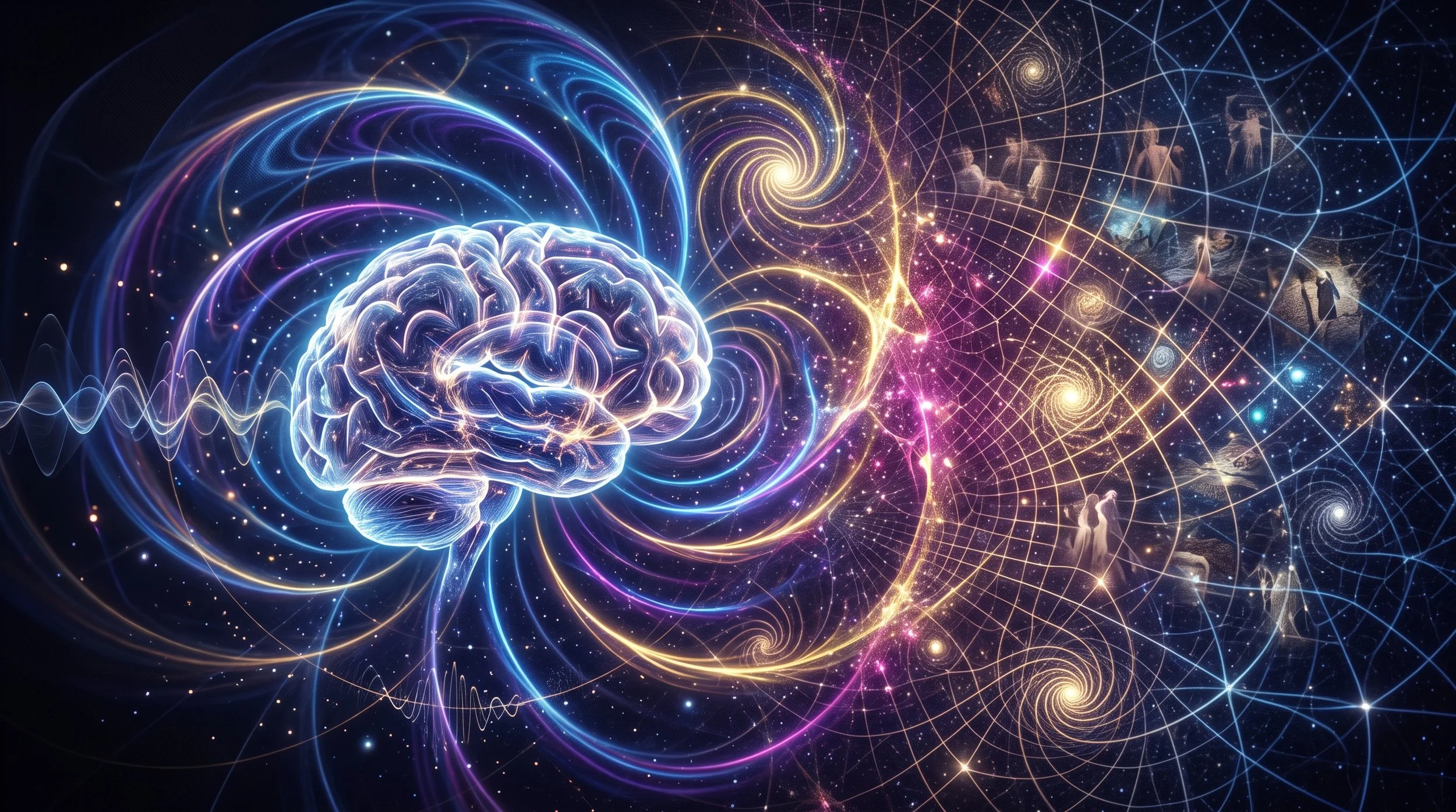
New studies reveal the moving geometry of neural activity. Could the act of remembering also involve a physical relationship between different moments of an experience?
Remember a familiar place. A doorway, a voice, the position of sunlight across a room: elements separated in the original experience can return together in recollection. Understanding this process requires explaining how activity across many neural populations becomes organized into a meaningful event.
Three studies bring the geometry of that organization into focus. They examine how brain activity travels, changes direction, and forms rotating patterns. These findings also offer a point of contact with a hypothesis I have been developing: that molecular systems inside neurons could participate in accessing information through relationships extending across spacetime.
Here I explore my quantum geometrodynamic memory-access hypothesis. Its distinctive proposal is that an earlier experience and its later recall form two ends of a time-symmetric physical relationship. The brain-wave studies establish properties of neural activity; the proposed connection between molecular states and events across time remains a hypothesis.
Memory in motion
A traveling brain wave involves a progression of neural activity across locations. Much as a stadium wave moves through spectators who remain in their seats, a collective neural pattern can propagate across populations of cells. Its frequency describes the rhythm’s rate, while its phase describes the position within each cycle. Spatial relationships among those phases give the wave its direction and shape.
In a 2024 Nature Human Behaviour study, Uma Mohan and colleagues examined direct human brain recordings during memory tasks. During successful memory encoding, theta and alpha waves tended to travel from posterior toward anterior regions. During recall, the preferred direction tended to reverse. These patterns varied across recordings, but the overall relationship suggested that wave direction carries information about the operation a neural network is performing. Whether changing that direction would alter memory remains an experimental question. Mohan et al., 2024
An April 2026 Nature Communications study by Anup Das and colleagues expanded the investigation beyond direction. Recordings from 24 patients performing spatial and verbal memory tasks revealed planar waves, rotating spirals, outward-spreading sources, inward-converging sinks, and more complex configurations. Their direction and strength changed with task stage. Wave features also distinguished some letters during presentation, allowing classifiers to extract information about stimulus identity. Separating the perceptual and mnemonic contributions to those letter-specific patterns remains important. Das et al., 2026
A third study, published in Science in June 2026, examined the anatomical foundations of rotating waves. Zhiwen Ye and colleagues combined imaging and electrical recordings in awake mice. They found waves sweeping across somatosensory maps, with a circular organization matching features of local axonal architecture. Related rotations appeared across hemispheres and sensory–motor regions, coordinated with activity in deeper structures. Bilateral cuts in the circular circuitry reduced rotating waves, supporting a causal contribution from that anatomy. Separate observations linked wave organization to correct visual–motor performance. Ye et al., 2026
Together, these studies give researchers measurable features of the activity accompanying cognition. They provide a useful target for any account of how a remembered experience becomes expressed throughout the brain.
An experience and its recall within spacetime
In the framework I developed in 2025, I approach memory through a four-dimensional description of physical events. In the block-universe picture adopted here, an experience and its later recollection occupy different locations in one extended spacetime history. The succession we live through follows a worldline: the path a physical system traces through space and time.
This picture changes how the question can be posed. The earlier event has a place in the four-dimensional description. The biological question becomes whether a present molecular configuration could establish a selective physical relationship with that event, making some of its information accessible again.
A block universe by itself supplies no such access mechanism. I add a specific hypothesis: organized molecular assemblies can participate in a quantum geometrodynamic circuit, a proposed connection whose physical description involves both quantum states and spacetime geometry. Molecular configurations serve as possible addressing conditions for that connection.
This account places the emphasis on direct access to an event through a temporal relationship. In my model, causal architecture is formed by geometrodynamic information flows, represented as geometrodynamic qubits. Biological systems orchestrate and direct these processes through their molecular organization.
Both ends of a proposed topological spacememory qubit are jointly established as one complete spacetime circuit. The later accession participates in producing the earlier memory trace. In this sense, memory is formed through its future re-experiencing in recall: the occasion of access helps establish the relationship that makes access possible. The two events occupy distinct coordinates, even though the circuit is specified as a whole.
A related idea appears in David Deutsch’s model of a qubit interacting with an older version of itself along a closed timelike curve. Ringbauer and colleagues experimentally simulated aspects of this model using photons in 2014. Their experiment reproduced hypothetical circuit dynamics; it did not create a physical closed timelike curve. Deutsch, 1991; Ringbauer et al., 2014
My article Retrocausal Teleportation Protocol explores a different approach, based on entanglement and postselected teleportation. In a 2023 thought experiment, Arvidsson-Shukur and colleagues showed how such a protocol could improve the information obtained per retained probe in a measurement task. These studies make temporal quantum relationships experimentally approachable and motivate the present proposal, while leaving biological trans-temporal access to be established. Arvidsson-Shukur et al., 2023
The quantum handshake
The inspiration for the temporal part of this proposal comes from Wheeler–Feynman time-symmetric electrodynamics and the later transactional interpretation of quantum mechanics developed by John Cramer. In this terminology, a retarded contribution relates an interaction to an earlier source; an advanced contribution relates it to a later boundary condition. Wheeler and Feynman developed a classical emitter–absorber theory using both. Cramer subsequently described quantum events through an offer wave and a confirmation response, often pictured as a handshake across spacetime. Wheeler and Feynman, 1945; Cramer, 1986
I propose that the later recall event participates in establishing the earlier memory relationship. In the language of my schematic, the molecular configuration at the recall coordinate β contributes an advanced confirmation to the event at α. The two endpoints jointly define a connection. In this account, memory formation therefore already involves the later occasion of access.
Describing an offer followed by a confirmation helps us picture the relationship, but the full transaction belongs to the entire spacetime interval. Within the block-universe account, there is one consistent history containing both endpoints. The future contribution is part of how that history is specified, rather than a second history being written over the first.
The step specific to my hypothesis is making that relationship biologically accessible. Cramer’s standard interpretation preserves conventional quantum predictions and does not provide controllable communication into the past. A molecular mechanism that adds a new observable information-access capability must therefore supply its own dynamics and predictions. Time symmetry supplies a conceptual starting point; the biological coupling is the proposed extension.
The A–B–A pathway
The mechanism can be followed through the same A–B–A sequence used in my original schematic. A and B denote distinguishable collective configurations of a molecular assembly. They are shorthand for a physical state that the model would ultimately need to define and measure.
At experience α, the assembly occupies A. Within the proposal, its relationship with the later recall configuration helps establish the circuit. The advanced confirmation from β participates in this formation. The experience and its eventual access are thus linked from the outset in the complete spacetime description.
During the intervening history, the assembly changes to B. Its local molecular dynamics continue. The proposed access relationship need not be represented by a permanently unchanged copy of configuration A throughout that interval.
At recall β, an incoming signal restores the relevant A configuration. My schematic assigns electrical or excitonic activity a possible role in this transition. An exciton is an electronic excitation that can be shared or transferred within a molecular assembly. Restoring A supplies the proposed matching condition for access to the event at α.
The accessed information then influences neuronal activity. In the proposed sequence, the molecular response affects photon signaling, which couples to electrical activity in dendrites and axons. That activity helps reinstate a distributed spatiotemporal pattern associated with the earlier experience. Each connection in this sequence is a physical claim that can be developed into a measurement question.
The reciprocity is essential: β participates in establishing the α–β relationship, while access at β makes information associated with α available to the biological system. My description of quasi-instantaneous accession expresses the intended possibility of rapid access through that connection. A transfer timescale has yet to be derived.
Microtubules as a proposed molecular interface
Why consider microtubules? These assemblies of tubulin contain organized networks of aromatic chromophores, including tryptophan residues that interact with ultraviolet light. Their arrangement offers a concrete setting in which to investigate collective optical behavior.
A 2024 study by Nathan Babcock and colleagues predicted superradiant states in large tryptophan networks and measured enhanced fluorescence quantum yield in microtubule architectures. These results motivate investigating how molecular organization affects optical response. Establishing a memory-related quantum register would additionally require identifying its states, coherence, preparation, and readout under relevant biological conditions. Babcock et al., 2024
My proposal gives collective molecular configurations a further role: stabilizing access relationships within a multiply connected spacetime geometry. It draws on the ER=EPR conjecture, in which Einstein–Rosen bridge geometry is associated with quantum entanglement. Maldacena and Susskind developed this connection for entangled black holes and conjectured a wider significance. Extending it to biological molecular systems is an additional step in my model. Maldacena and Susskind, 2013
The phrase topological qubit names the proposed information-bearing role of these configurations, illustrated by the braiding analogy above. In my model, the geometrodynamic circuit includes physically traversable Einstein–Rosen bridges: a photon or an electrical influence can pass through the proposed geometry between timelike-separated events. This traversability is a further postulate of the model, beyond the ER=EPR conjecture. Its realization in tubulin would require a physical account of the states, their protection, and their coupling to neuronal activity.
Spirals as an observable expression of recall
This connection to brain-wave geometry is central to the proposal’s digital–analog hybrid mechanism. The digital component consists of discrete operations of the proposed topological qubits associated with microtubules. These operations generate electrical and electromagnetic states that contribute to collective neuronal gestalts—coherent patterns of activity distributed across many cells. The analog component is their continuously varying expression in structured spatiotemporal brain waves, including traveling fronts, spirals, sources, and sinks.
The interaction is reciprocal. In the hypothesis, these brain-wave patterns feed back into microtubule networks and influence subsequent molecular operations. I propose that ephaptic coupling is especially relevant to this return pathway. Ephaptic coupling is the modulation of neuronal activity by extracellular electric fields, a measured physiological phenomenon. Extending that influence to selective control of the proposed microtubule qubits is the additional molecular coupling proposed here. The resulting loop links molecular state selection, collective neural activity, and renewed molecular state selection. Anastassiou et al., 2011
For the hypothesis, the most informative result would be a reproducible, reciprocal relationship between a defined molecular state and a content-specific cortical pattern. Wave direction, rotation, convergence, and divergence offer measurable features of that relationship. Simply observing a spiral would leave the mechanism undetermined. A spiral phase pattern across cortex also differs geometrically from a three-dimensional torus or a proposed microscopic spacetime connection. Relating these levels requires measurements and a model of their coupling.
What would test the connection?
The first requirement is a physical definition of A. Many experiences can share similar molecular states, so resemblance alone cannot select a unique memory. The model needs a selection rule that explains which event becomes accessible and why competing events do not produce the same readout.
The next requirement is a quantitative description of the traversable-bridge coupling between α and β. The proposed route is through the multiply connected geometry of the circuit. Developing this claim requires specifying that geometry, what sustains its traversability, how a photon or electrical influence enters and exits, and the expected signal strength and timing. The same account must explain how the received influence produces a selective neuronal readout.
Experiments could then measure candidate molecular configurations alongside neuronal and cortical activity during encoding and recall. Perturbing a defined configuration should change the predicted timing, geometry, or recalled content in a way the model specifies. Conversely, controlled changes to extracellular field patterns should produce the predicted molecular response. Both directions require controls for ordinary cytoskeletal, synaptic, and metabolic effects.
The retrocausal teleportation work provides a useful model for making the temporal claim precise. Its proposed metrological advantage is conditional on postselection: later outcomes identify the retained trials. The prediction can be tested without assuming that a controllable message has reached the past. A memory-access experiment must likewise specify its preparation, later conditions, readout, and selection rules, and compare the results with a quantitative conventional model. If the hypothesis predicts an additional dependence of earlier encoding outcomes on independently chosen later recall conditions, that dependence should be stated in advance. The analysis must separate the predicted effect from information leakage and correlations induced by selecting trials according to later outcomes, and account for the observed limits on signaling. Arvidsson-Shukur et al., 2023; Wharton, 2018
The proposal gives these questions a specific form: can a recurring molecular configuration make an earlier event biologically accessible through a relationship in which future recall already participates? The new studies describe the moving geometry that accompanies memory. The next task is to determine whether that geometry can be connected, through a measurable molecular mechanism, to the temporal relationship proposed here.
