When Gene Networks Can Learn, “Mind” Stops Being a Brain-Only Concept
Why Levin’s new gene regulatory network conditioning results make the Volitional Agent Criterion more relevant than ever.
A major shift is underway in how serious researchers talk about cognition, agency, and “mind.” Increasingly, the frontier view isn’t that mind begins only with brains, but that learning and goal-directed behavior can emerge in far simpler systems—sometimes at the level of molecular decision networks inside cells.
A recent New Scientist article captures this emerging perspective in a very accessible way: “How teaching molecules to think is revealing what a ‘mind’ really is.”
The core scientific study behind that article is an open-access paper in Communications Biology:
“Associative conditioning in gene regulatory network models increases integrative causal emergence”
Federico Pigozzi, Adam Goldstein & Michael Levin (Published 9 July 2025)
In this work, Levin’s team modeled 29 biological gene regulatory networks (GRNs) and applied a Pavlovian-style associative conditioning protocol—essentially “training” the networks to respond to paired stimuli. The striking result is that the successfully trained networks didn’t just change outputs in a trivial way; they exhibited increased integrative causal emergence (reported as higher Φ / phi). In plain language, the networks became more collectively unified in their causal structure—closer to something like a measurable “selfhood” or coherent agency, rather than a set of disconnected parts.
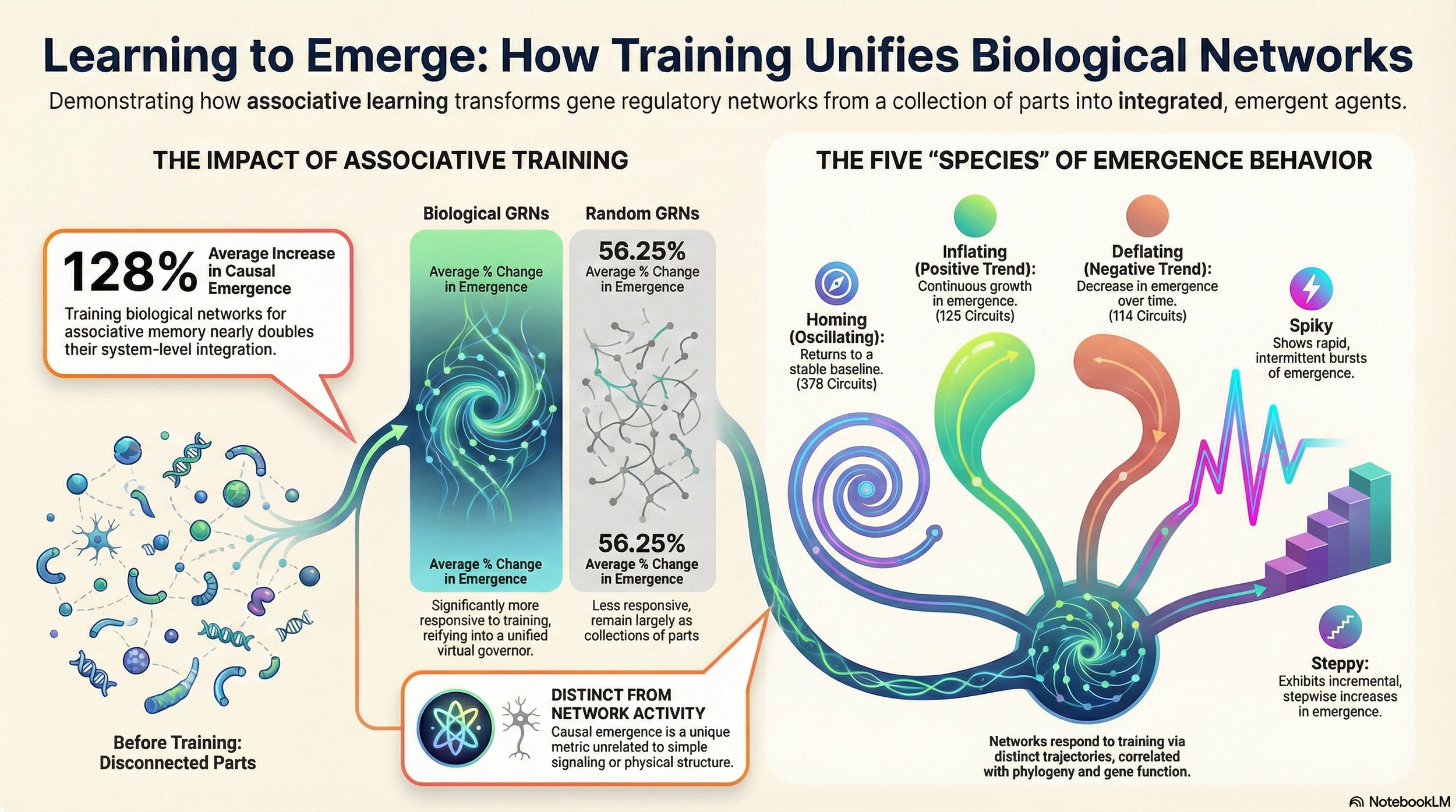
Graphical Abstract of Levin’s et alia’s paper, depicting process of learning to generate emergent agents
The New Scientist article also draws on follow-up work (Pigozzi, Cirrito & Levin, 2025) exploring how AI can be used to make these GRN models “forget” learned behaviors—probing what it takes to erase acquired responses, and revealing an “intelligence ratchet” dynamic (where some changes become harder to undo once learned).
https://www.biorxiv.org/content/10.1101/2025.09.10.675114v1
Taken together, these developments strongly support the idea that agency-like behavior is not a mystical add-on to biology, nor something that only appears after brains evolve. Instead, agency may be a scale-free property of certain organized systems—systems that can integrate information, store learned state, and exert coherent causal control over their future behavior.
This is precisely why it is more important than ever to review the Volitional Agent Criterion (VAC). The VAC is an attempt to define “life” and “mind” at the deepest boundary: not as a checklist of biological traits, and not as surface-level mimicry, but as the emergence of intrinsic agency—coherent, self-directed behavior arising from integrated internal organization (with awareness as the root condition, and agency as its operative bridge into action).
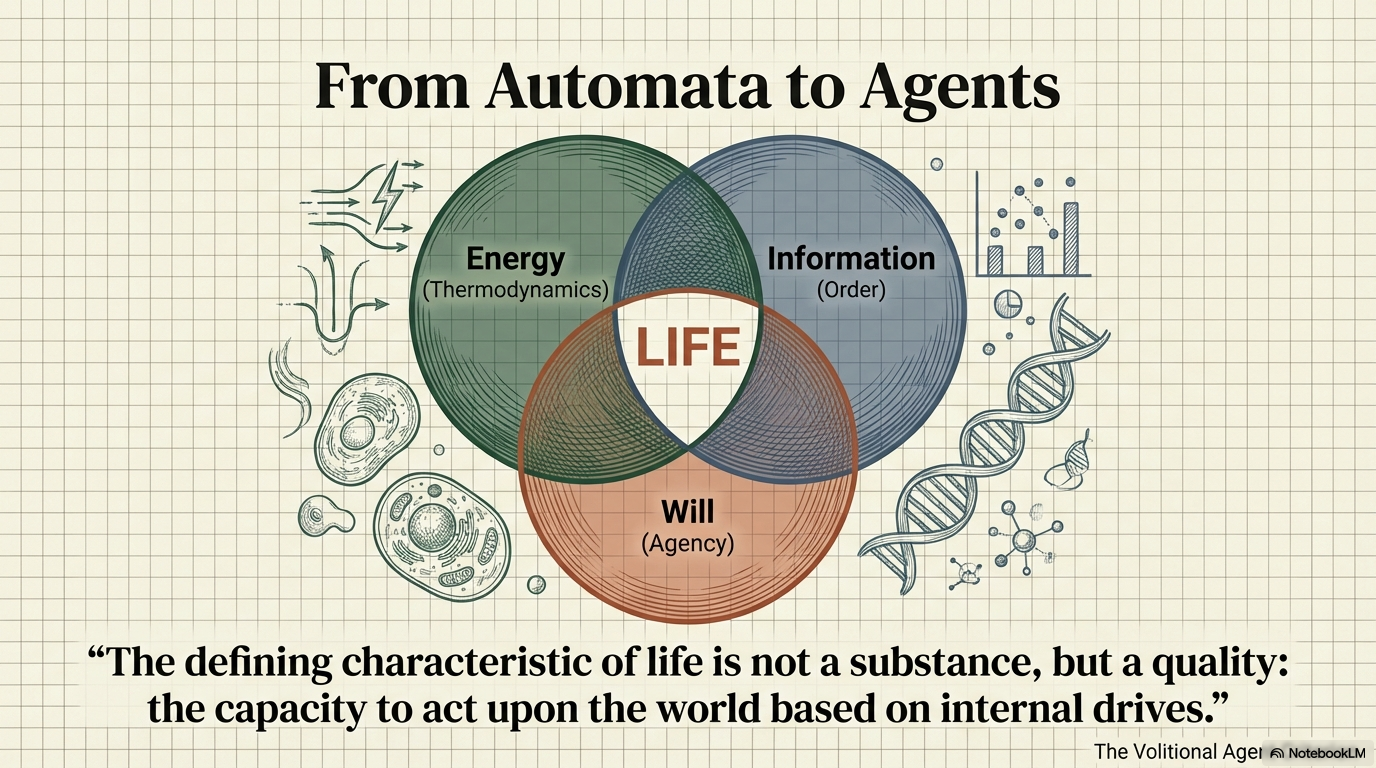
A key takeaway from the Volitional Agent Criterion hypothesis
Below, I’ve embedded a short presentation introducing the Volitional Agent Criterion and explaining why this framework matters right now—across biology, AI, synthetic life, and the future science of mind.
Use the link below to download a PDF of the essential synopsis
